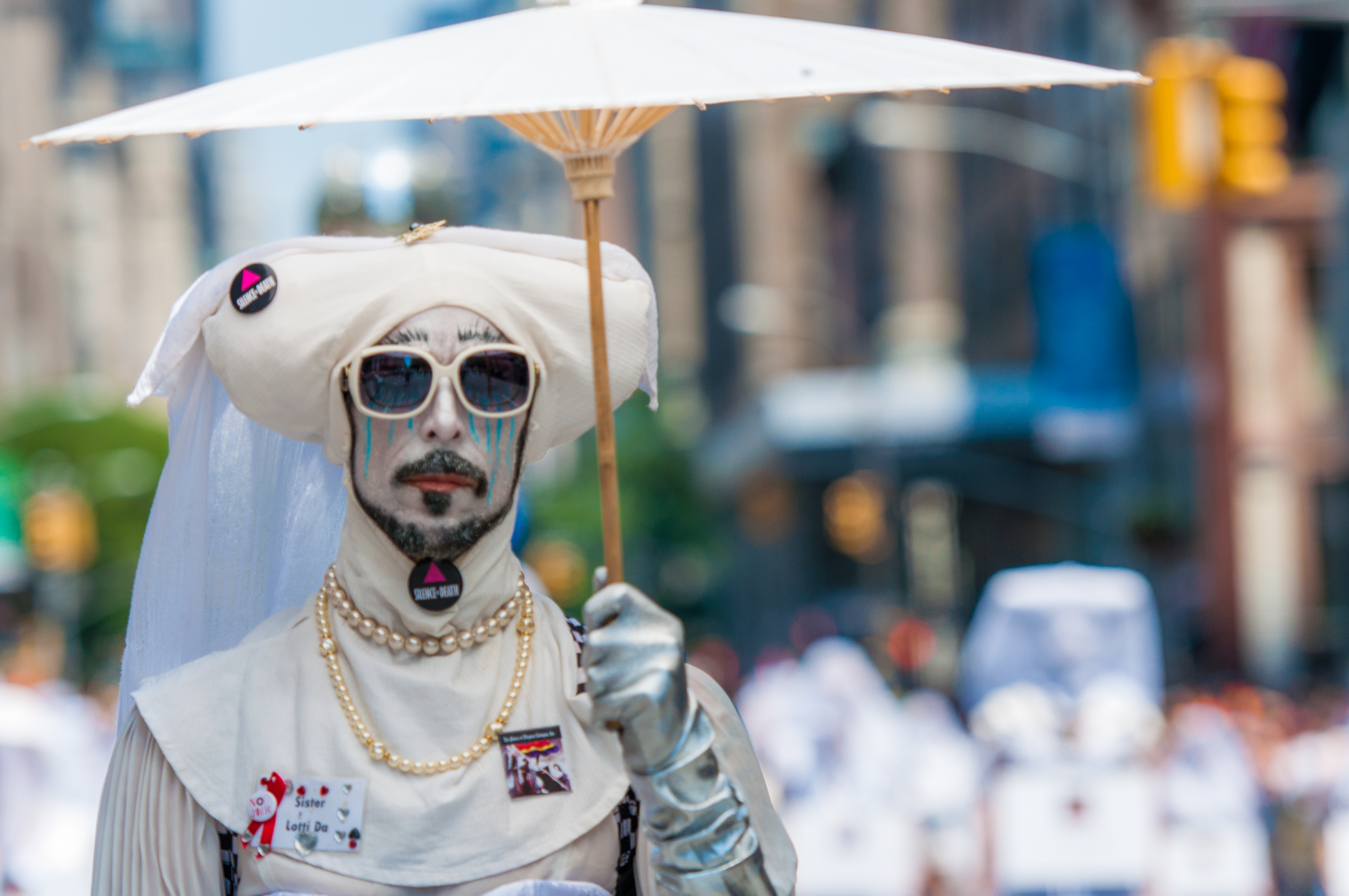
Activism takes on many forms, some people protest, others organize, still others perform, and then there’s the artists. For AIDS awareness month I interviewed Hucklefaery (aka Sister Lotti Da) in his Brooklyn apartment. To meet him you realize that he is an activist that embodies all of the above.
Dressing up like an eight foot nun…psychedelic nun, pushes a lot of buttons for people, even within the community
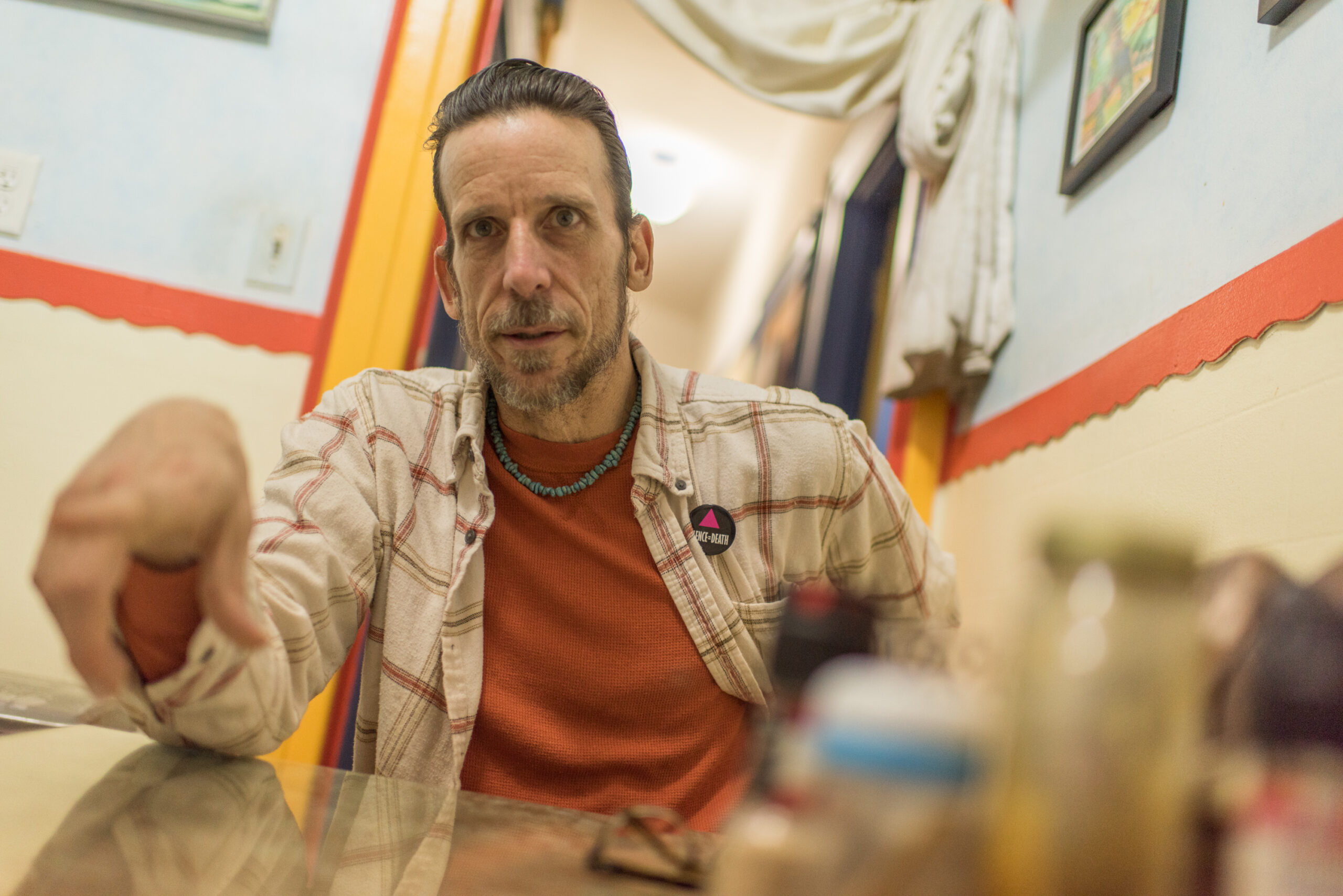
The first time I saw Hucklefaery I was photographing the Pride March which took place shortly after the Pulse Nightclub shooting that had happened in Orlando earlier this year. The shooting was a large part of the theme of the march, however there was one tribute that stood out from all of the other groups that day. They called themselves 49 Human Beings, after the number of those that were lost in the Pulse shooting. They dressed in white, with veils covering their faces, and silently proceeded down the parade. On each of their chests there was a placard with the photograph, the name, and age of each of the victims of the Pulse shooting. Hucklefaery was leading the procession dressed as Sister Lotti Da; umbrella in hand, dark sunglasses with white rims, a white victorian girdle, white make-up and blue tears streaming down his face. I met him again as Sister Lotti Da, while I was photographing the AIDS memorial park dedication in St. Vincent’s Triangle in New York. Again, he had a white painted face, but this time it was accented with red and he had an outfit to match. When I went to interview him at his home I wasn’t quite sure what to expect because I’d never seen him outside of the persona of Sister Lotti Da. Hucklefaery is a tall man. At 6’3” he is already an imposing figure, however when he dresses as Sister Lotti Da and puts on five inch heels and a six inch wimple he is impossible to ignore. This is how he delivers his message, a message of awareness about the gay community and the issues they face. Issues such as violence, stigma, marginalization and access to healthcare. He feels that Sister Lotti Da is a celebratory figure which makes his message accessible. This delivery is a cross between protest and art, activism and education.
He first became an activist in college with Amnesty International, then when he moved to New York, he became a founding member of both Americorps and the Harlem Peacemakers (http://hcz.org/our-programs/peacemakers/). When he first joined the Harlem Peacemakers, Harlem was a community that he was initially an outsider to, but they soon embraced him. Coincidentally there was a disturbing commonality. As it turned out, he had lost almost all of his gay male friends, and many of his colleagues had also lost a number of their male friends and family. The difference was that his friends were lost to AIDS (he had graduated high school in 1984 when the AIDS epidemic was on the rise and more and more people were dying), and their friends had been lost to gun violence. The similarity was striking and he felt that activism, even for a community that he was outside of, was the right thing to do.
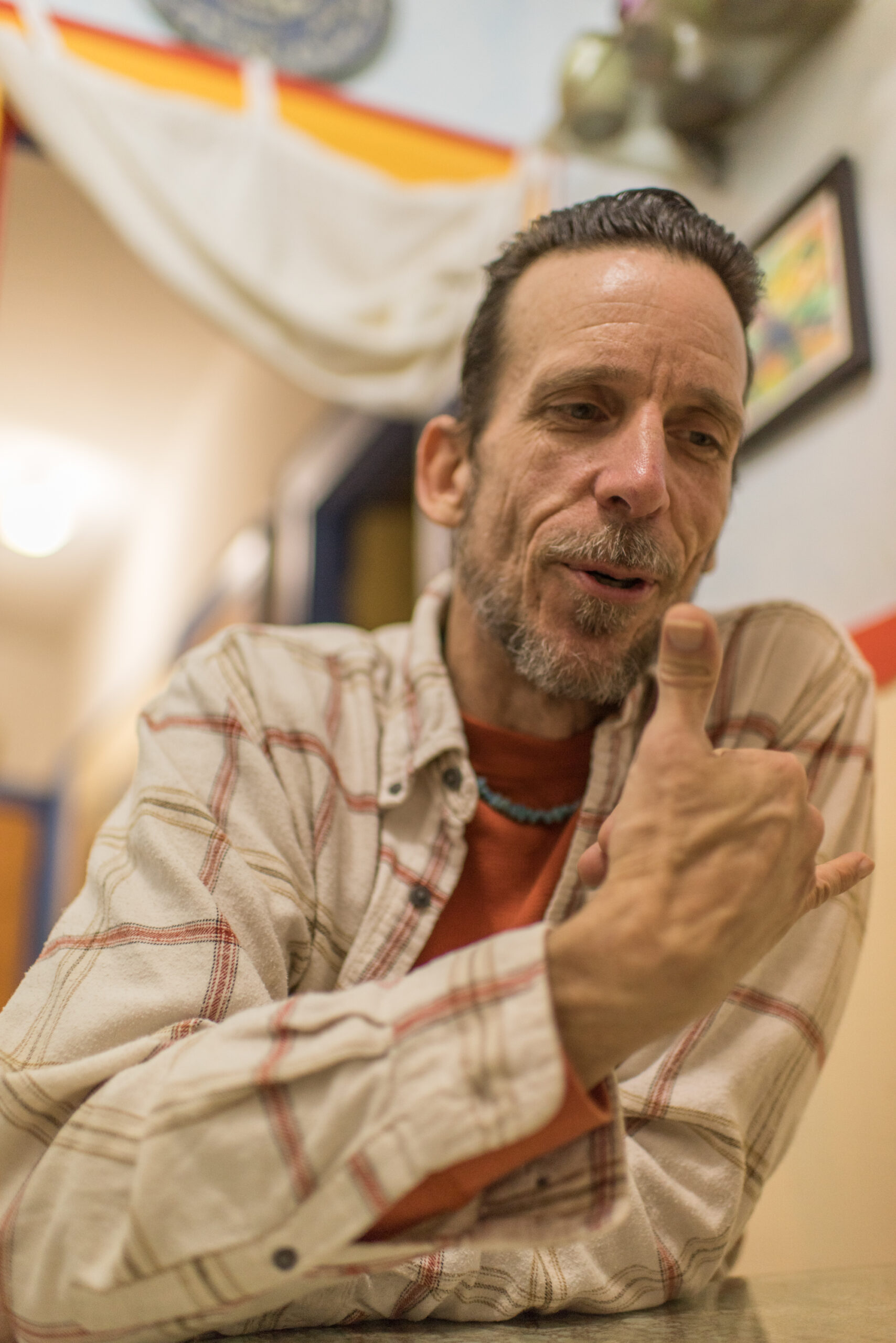
He started doing AIDS activism 20 years ago as Sister Lotti Da with the Sisters of Perpetual Indulgence (http://www.thesisters.org/) before it was a personal issue. Since then, in 2000, he seroconverted (meaning that the HIV antibodies develop and become detectable), and immediately after that he became acutely ill and had to go on the treatment cocktails for his survival. Now AIDS activism wasn’t only about his friends being trapped in the dire social context of the disease but also became about his own health and safety. Living with AIDS he has to cope with the high cost of medication and treatment. The high cost is not only monetary, but physiological as well. It turns out that he doesn’t tolerate the medications very well, and he points out that this intolerance to treatment is more common than people are lead to believe. If you look at the literature and advertising about AIDS, a positive picture is painted of those on treatment. Even though fewer people are dying from AIDS, the reality is that many people are struck with a litany of side effects including diarrhea, high blood sugar, liver problems, nausea, vomiting, rash, jaundice, and the list goes on depending on the regimen (and personal tolerance to that regimen) that they are receiving. Living with AIDS is not an easy task, though he feels fortunate to still be alive, Hucklefaery has been chronically sick from the treatments, gone bankrupt twice trying to meet the cost, and even needed public assistance shortly after his diagnosis.
Through all of this he keeps doing his art, the art of activism, the art of the ‘living memorial’ as he calls it. The living memorial is a different kind of protest, if you could even call it a protest. It is more of a statement, something that goes beyond megaphones and picket signs, something profound that catches the eye and makes people take notice. 49 Human Beings was organized as part of Gays Against Guns, or GAG (http://www.gaysagainstguns.net/), and is an example of the living memorial. This style in his words is “a sacred intersection of demonstration, ritual, and in a way, theatre”, which gets the message across, but is not thrusting it into people’s faces by yelling at them. Yelling makes people shut down, and in the end the message is lost. There is a personal attachment to this type of statement. When 49 Human Beings was being organized, each of those involved were asked to research the person that they represented. This humanized the Pulse Nightclub victims, and as such, each of the participants marching pulled cues from the lives of the name that they carried. People carrying names of couples marched together maintaining their relationship after death, and one even wore a graduation gown because the person they represented had not graduated yet. The living memorial is human and fluid in its execution.
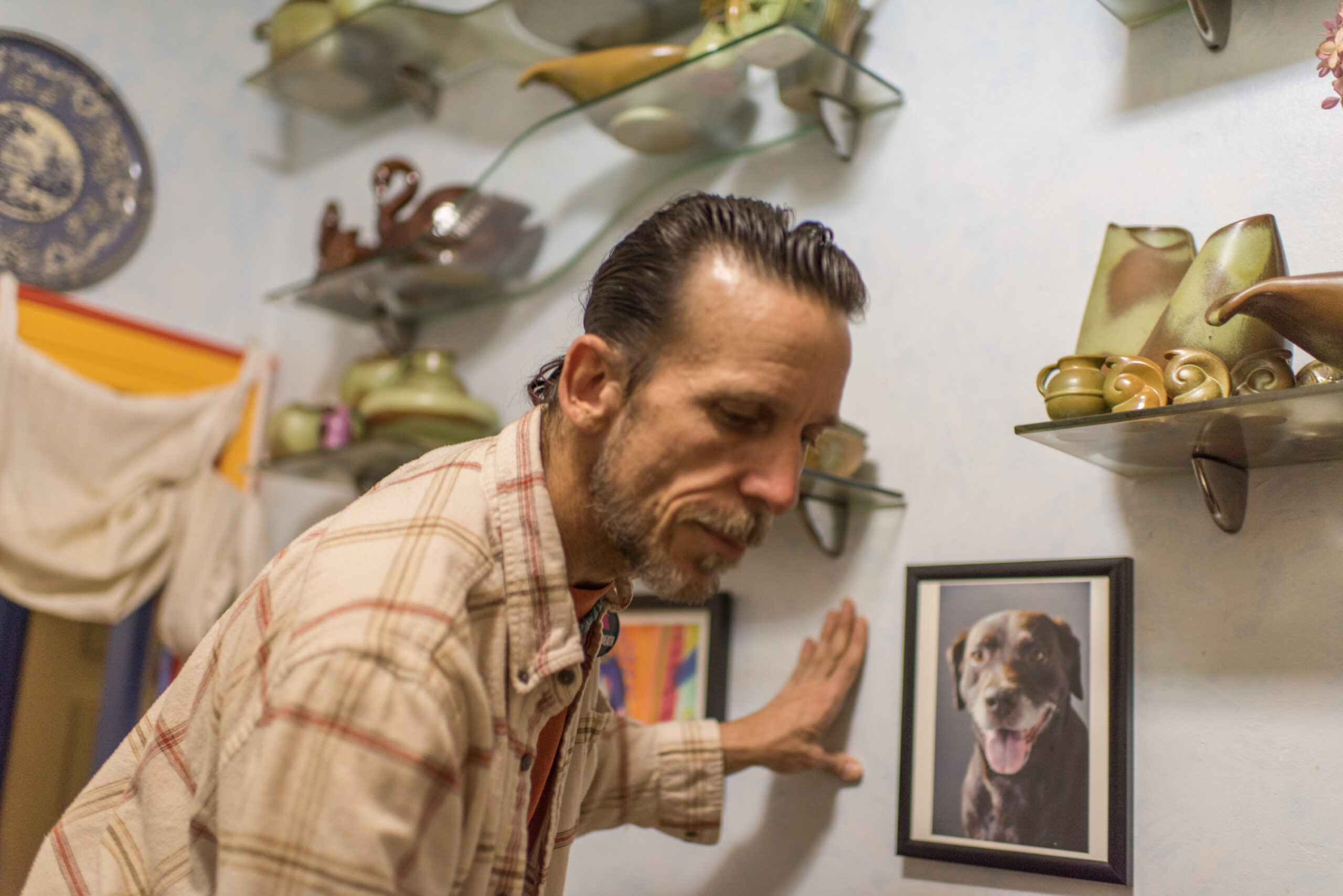
His style is not without criticism though. As it turns out dressing up like an eight foot nun pushes people’s buttons, both outside and inside the community. Hucklefaery notes that there is a divide between transgender people and people that dress in drag. Drag can be interpreted as making fun of the transgender community, as was the case during the women’s liberation movement which also saw drag this way. Drag is something that you put on and take off, it is a character you play, while transgender people are tied to their identity, and this is where the divide lies. Hucklefaery means no disrespect to transgender individuals when he dresses as Sister Lotti Da, rather he sees Sister Lotti Da as more of a Shakespearean sacred fool, one who speaks the truth and is actually a voice of reason. Sister Lotti Da is a sacred fool with a mission to change the way things are.
